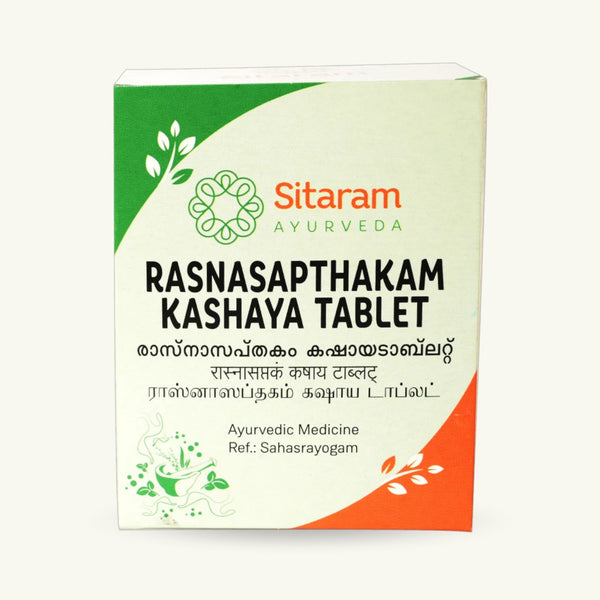
The classical Rasnasaptakam Kashayam has long been valued in Kerala's Ayurvedic texts. In tablet form it keeps the character of the traditional decoction while fitting neatly into a modern daily routine.
A classical formula in a modern form
These tablets are prepared from a traditional Kashayam, a herbal decoction, built around Rasna together with companion botanicals such as Eranda, Punarnava and the classical group known as Dashamoola, the ten roots. Presenting the decoction as a tablet allows accurate, unfussy dosing for busy days.
The classical Ayurvedic view
Traditional theory describes this formula as Vatahara, settling to Vata, and Srotoshodhaka, clearing to the channels, while relating it to a balanced Kapha. It is also linked in the texts with the gentle clearing of ama, the classical idea of unprocessed residue. These are classical concepts of balance, not descriptions of a health outcome.
Traditional use in daily routine
- Traditionally taken on an empty stomach with half a glass of lukewarm water, morning and evening.
- Classically kept alongside warm baths and moderate, regular movement.
- Traditionally used away from excess cold and damp, in keeping with a Vata-settling routine.
Follow the serving size printed on the product label, or a personalised plan from a qualified Ayurvedic practitioner, who can account for age and individual constitution.
Frequently asked questions
What is Dashamoola? It is the classical group of ten roots often woven into traditional formulas of this kind.
How is it usually taken? On an empty stomach with lukewarm water, morning and evening, as a steady routine.
Food supplements are not a substitute for a varied and balanced diet and a healthy lifestyle. Do not exceed the recommended daily intake.